The Dutch Exit: Wedding Trend or Taboo?

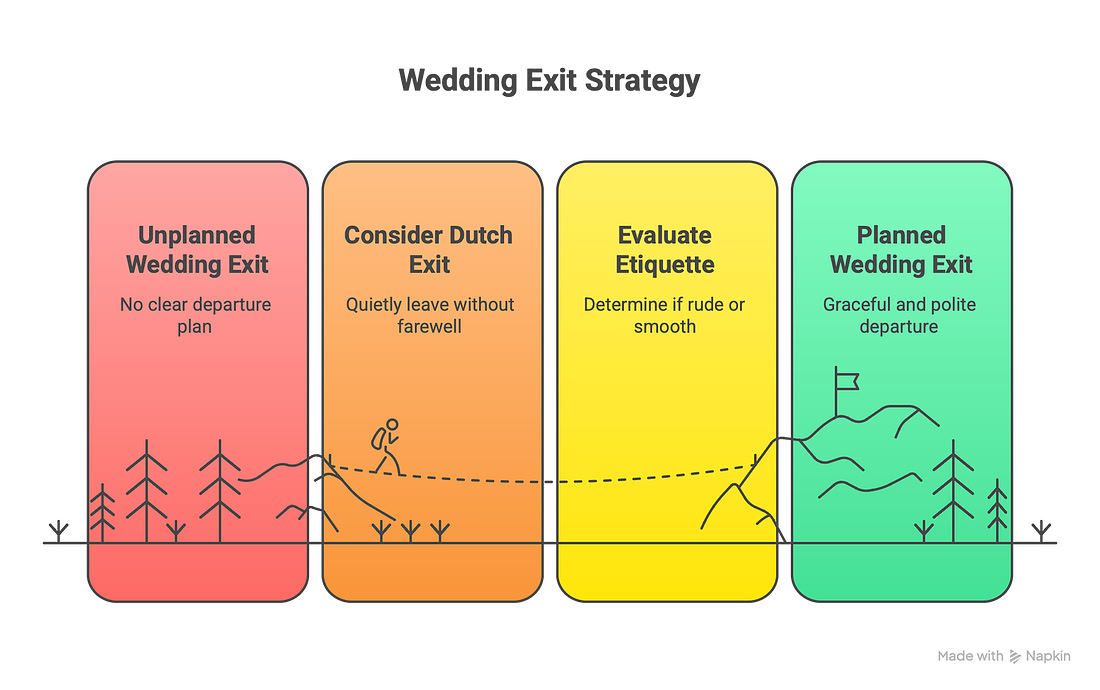

Your wedding day is one of the most unforgettable days of your life. The laughter, the happy tears, the music pumping on the dance floor, it all comes together in a blur of joy. But as the night winds down, there is one question that does not get talked about much: should you or your vendors make a Dutch Exit?
If you have ever left a party without saying goodbye, congratulations, you have already mastered the concept. A Dutch Exit is essentially slipping out quietly without a formal farewell. But when it comes to weddings, does this smooth exit style make sense, or does it come off as rude? Let’s break it down.
What Exactly is a Dutch Exit?
In social terms, a Dutch Exit sometimes called a “French Exit” depending on who you ask is leaving a gathering without saying goodbye to every single person. At a wedding, it can apply to couples or vendors.
For couples, it could mean slipping away while guests are still having a blast, instead of pausing the music for a grand farewell.
For vendors, it usually means finishing coverage, packing up, and leaving without pulling the bride and groom away from the fun for a formal goodbye.
It is simple, it is efficient, and in some cases, it is considerate. But weddings are not just any party, they are milestone events. Which begs the question, when is a Dutch Exit acceptable, and when is it not?
When a Dutch Exit Might Be Acceptable
For Couples
-
Late night celebrations: If the dance floor is packed and the party is still going strong, some couples slip out without a big announcement. Guests keep dancing, the vibe stays high, and the focus remains on celebration rather than formality.
-
Destination or adventure weddings: Elopements or smaller destination weddings often lend themselves to a more relaxed approach. Saying goodbye to 20 guests is manageable, but at a 200 guest Montana ranch wedding, you might not want to interrupt the line dancing just to make a speech.
For Vendors
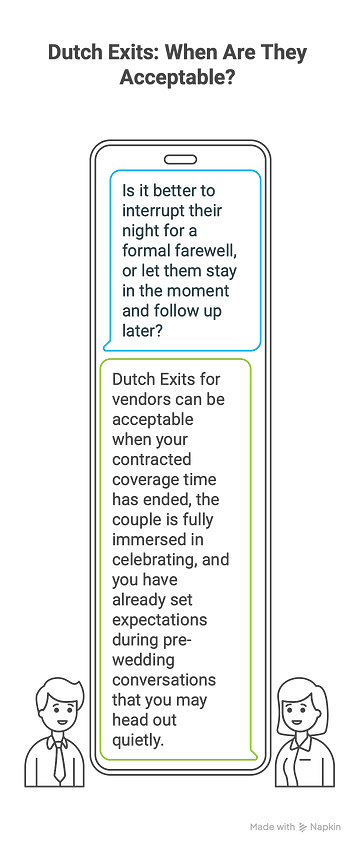
Here is where things get interesting. As a photographer, I have been there. Once, I was able to speak with the groom before leaving, but I did not get to say goodbye to the bride. It was not a complete Dutch Exit, but it made me think: is it better to interrupt their night for a formal farewell, or let them stay in the moment and follow up later?
Dutch Exits for vendors can be acceptable when:
-
Your contracted coverage time has ended.
-
The couple is fully immersed in celebrating.
-
You have already set expectations during pre wedding conversations that you may head out quietly.
When a Dutch Exit is Not Okay
For Couples
-
Too early in the night: Disappearing before key moments like cake cutting or first dances leaves guests confused and sometimes disappointed.
-
With VIP guests still waiting: If grandparents or parents expect a goodbye, ducking out may unintentionally hurt feelings.
For Vendors
-
Leaving before the timeline ends: If a sparkler exit is still on the schedule, disappearing early is never a good look.
-
No communication: If you have not discussed the possibility of a Dutch Exit with your couple, it can feel abrupt or unprofessional.
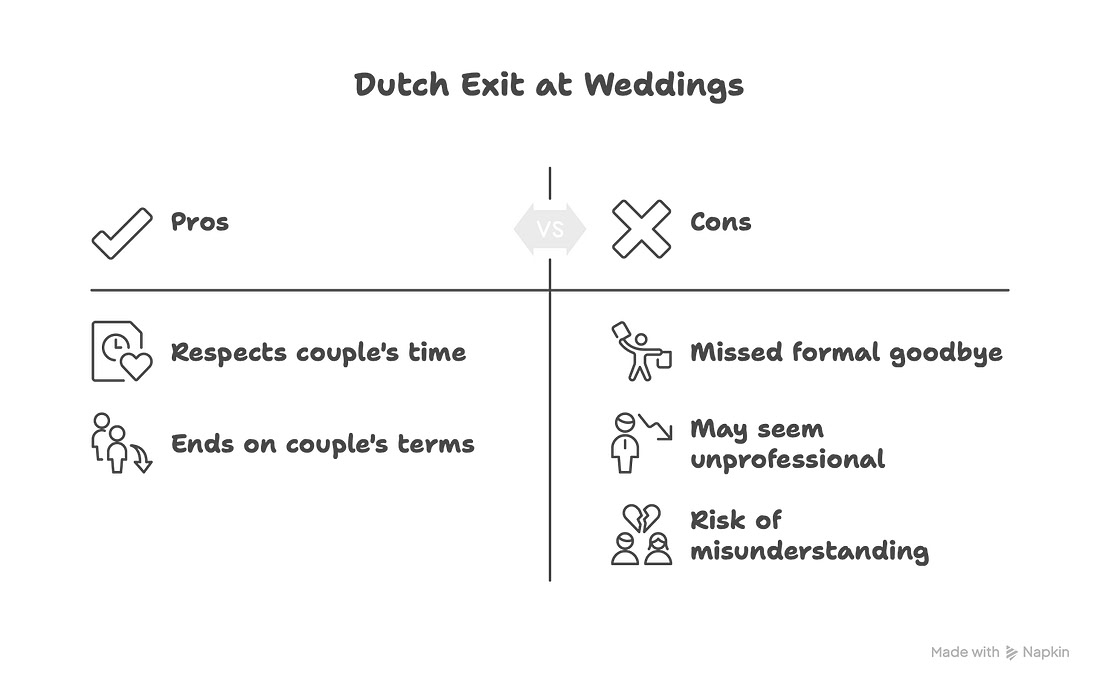
The Pros of a Dutch Exit
Why would anyone choose a quiet exit on such a big day? Believe it or not, there are some advantages.
-
Keeps the vibe alive: Nothing kills dance floor energy like halting everything for a round of hugs.
-
Saves emotional energy: Weddings are long, and sometimes couples do not want to say 50 separate goodbyes at midnight.
-
Efficiency for vendors: Quietly packing up keeps the spotlight on the couple and the celebration, not on the cleanup crew.
-
Natural close to the night: It allows things to end organically without forcing a “final moment.”
The Cons of a Dutch Exit
Of course, it is not all smooth sailing. Dutch Exits come with downsides too.
-
Can feel impersonal: Some guests may feel slighted if they do not get a personal goodbye from the couple.
-
Missed opportunities: Vendors who leave without a word might lose that final personal touchpoint to thank the couple in person.
-
Miscommunication risk: If the couple expected photos of a late night moment, leaving early could cause disappointment.
-
Perception matters: For older generations, not saying goodbye can still feel like poor etiquette.
Dutch Exits in Montana Weddings
Here in Montana, weddings often take place at wide open venues, barns in Paradise Valley, ranches near Bozeman, lakeside celebrations at Yellowstone. These spaces naturally encourage a laid back vibe. In that context, a Dutch Exit can sometimes feel fitting.
For example, at an outdoor summer wedding in Big Sky, guests may be scattered between the dance floor, fire pits, and stargazing. Slipping away can feel more natural than rounding everyone up for a farewell. On the flip side, formal ballroom weddings in downtown Bozeman may lean toward a more traditional goodbye.
A Thoughtful Approach for Vendors
As vendors, our job is to serve the couple while respecting the flow of their day. A Dutch Exit can work if handled thoughtfully:
-
Set expectations early: Let couples know in pre wedding calls or contracts that if they are fully engaged with guests when your time is up, you may slip out quietly.
-
Deliver gratitude later: Send a heartfelt thank you email or message the next morning. Something like, “I did not want to pull you away from the celebration last night, but I am so grateful I got to capture your day.”
-
Stay professional: Quiet exit does not mean disappearing without a trace. Always ensure all gear is packed, timeline tasks are covered, and any important notes are communicated to the planner or coordinator.
Final Thoughts: Should We Talk About This More?
The Dutch Exit at weddings raises some interesting questions. For couples, it can be a way to end the night on their own terms. For vendors, it can be a way to respect the couple’s time and energy. But is it always the right move?
Should vendors quietly slip out once their coverage is finished, trusting that a thank you message the next day is enough? Or is it better to interrupt the couple for a formal goodbye, even if it means pulling them away from the dance floor?
There is not one perfect answer, which is why I would love to hear what you think. After all, weddings are as unique as the people in them, and maybe the Dutch Exit deserves a spot in the conversation right alongside sparkler exits and first looks.